China Top Printed Label Stickers Manufacturer Supplier
China has become a significant production base for customized packaging and labeling solutions. Its printing industry combines advanced flexographic equipment, digital presses, automated inspection, and diverse material sourcing. For global buyers, this creates more choices in color accuracy, adhesive performance, finishing, and order flexibility.
According to Grand View Research, the global labels market was valued at approximately USD 45.8 billion in 2023. The report expects continued growth through 2030, supported by e-commerce, food packaging, personal care, and logistics. Smithers also identifies digital printing and shorter production runs as important developments in the future of labels. These trends are changing how brands evaluate printed label stickers. Price remains important. It is not the only factor.
A reliable China supplier should provide more than attractive samples. Buyers need documented material specifications, adhesive testing, color-management procedures, and traceable quality inspections. A label may look excellent under showroom lighting, yet fail on a cold bottle or dusty carton. Small details matter, such as liner release, barcode clarity, edge lifting, and resistance to moisture. Suppliers with practical experience can recommend paper, film, thermal, or specialty stocks according to the application.
However, manufacturing strength does not remove every risk. Communication gaps, inconsistent artwork files, and unclear tolerances can still delay production. A professional supplier should acknowledge these weaknesses and improve them through proof approval, sample testing, and inspection records. Choosing a China printed label stickers manufacturer means evaluating evidence, not promises. Consistent quality builds trust. That process deserves careful attention.
Printed Label Stickers: Definition and Main Applications
Printed label stickers are self-adhesive materials with customized text, images, symbols, or codes. They usually include a printable face stock, adhesive layer, and release liner. The face stock may be paper, film, or another engineered material. Each option performs differently.
Paper feels natural and suits dry packaging. Film handles moisture, abrasion, and frequent handling better. Adhesive choice depends on surface texture, temperature, and application speed. A smooth carton needs different bonding behavior from a dusty plastic bin. During production, experienced manufacturers check color consistency, print sharpness, adhesive coverage, and cutting accuracy. They also test labels on actual containers. Small details matter. A label may look perfect indoors but peel after refrigeration or sunlight exposure. No specification replaces a real-use trial.
Printed label stickers support many daily applications. Retail packaging uses them for product names, sizes, instructions, and decorative graphics. Cosmetic bottles often need clean labels that resist water and oils. Shipping cartons use barcode labels for sorting and inventory control. Warehouses apply labels to shelves, storage bins, and equipment. Jars, envelopes, electrical parts, and promotional materials also benefit from flexible labeling. Variable printing can add batch numbers, dates, or scannable codes. Yet crowded artwork can reduce readability. Reflective film can weaken scanning performance. Careful testing remains necessary, especially when labels face heat, moisture, friction, or repeated movement.
Types of Printed Label Stickers and Their Material Options
China Top Printed Label Stickers Manufacturer Supplier
Printed label stickers combine identification, protection, and shelf appeal. Their material choice affects durability, printing quality, and recycling outcomes. A 2024 global printed-labels market assessment valued the sector above US$45 billion. It also forecasts steady growth through 2030, driven by food, beverage, logistics, and personal-care packaging.
Paper labels suit boxes, jars, and indoor products. They offer a natural texture and sharp color reproduction. However, moisture can cause curling or ink damage. Polypropylene labels resist water, oil, and abrasion, making them practical for chilled bottles and bathroom products. Polyethylene is softer and conforms well to squeezable containers. Polyester provides stronger tear and heat resistance for industrial identification. Polyvinyl chloride can perform well outdoors, but its environmental profile requires careful review.
Small details matter. A matte finish reduces glare under store lighting. Gloss coating strengthens color contrast. Permanent adhesive works for long-term use, while removable adhesive supports temporary labeling. A pressure-sensitive adhesive must match the container surface and temperature range. Otherwise, edges may lift.
A 2023 packaging study reported that consumers increasingly notice recyclability claims and material transparency. That does not mean every paper label is automatically greener. Inks, coatings, liners, and adhesive residues can complicate recovery. I have found that choosing the cheapest substrate often creates rework later. Testing remains essential. Check adhesion after refrigeration, rubbing, and humidity exposure before approving production.
How Printed Label Stickers Are Designed and Manufactured
How Printed Label Stickers Are Designed and Manufactured
Printed label stickers begin with a practical question: where will the label be used? Paper suits dry indoor packaging, while synthetic films resist moisture, oil, and abrasion. Designers select the face material, adhesive, finish, and label size together. A small change can affect peeling, readability, and production cost.
Artwork is prepared with clear dimensions, safe margins, and accurate color references. Important text should remain readable at the final size. Production specialists check barcodes, fine lines, coating areas, and die-cut paths before printing. Digital printing works well for short runs and variable designs. Flexographic printing often supports larger quantities efficiently. A physical proof still matters. Screens can hide small problems.
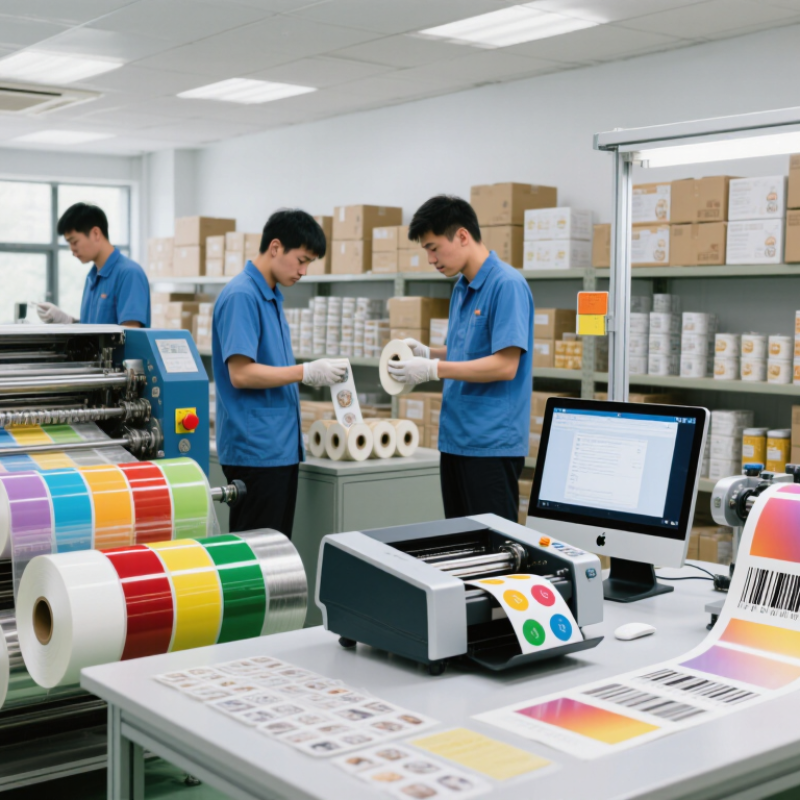
The selected material passes through printing, drying or curing, coating, and cutting. Rotary dies shape each sticker, while slitting equipment divides finished rolls to the requested width. Inspectors check color consistency, adhesive performance, edge quality, and winding tension. Samples may be applied to glass, cardboard, or textured surfaces under realistic conditions. A label that looks excellent may still fail on a dusty carton. That mistake is easy to overlook. Careful suppliers record batch details and keep approved samples for comparison. Even experienced teams sometimes adjust pressure, ink density, or curing time after the first production check. Reliable manufacturing depends on those small corrections, not just attractive artwork.
Common Face-Stock Thicknesses for Printed Label Stickers
These representative nominal values reflect commonly specified face-stock thicknesses used in printed labels. Paper, BOPP, PET, and PE materials are selected according to the required flexibility, moisture resistance, durability, and printing performance.
Key Factors for Choosing a Label Sticker Manufacturer
China Top Printed Label Stickers Manufacturer Supplier
Choosing a label sticker manufacturer requires more than comparing unit prices. MarketsandMarkets estimates the printed labels market will grow from about USD 48 billion in 2023 to over USD 60 billion by 2028. This growth increases supplier choices, but not necessarily supplier quality. Request production samples first. Check edge cutting, color consistency, adhesive strength, and barcode readability under normal lighting. Small details matter.
Material selection should match the application. A label for a chilled bottle needs moisture resistance and an adhesive that survives condensation. Packaging labels may require rub resistance, clean color reproduction, and stable dimensions. Ask for technical data sheets, batch records, and documented quality checks. A reliable supplier should explain tolerances clearly, not hide behind attractive samples. Lead time also deserves attention. Confirm proof approval, production scheduling, packing methods, and replacement procedures for defective rolls.
The Smithers report, The Future of Labels and Labeling to 2028, identifies sustainability and digital production as important forces in label manufacturing. Therefore, ask about thinner materials, liner reduction, recyclable structures, and waste control. Certification can support trust, but paperwork alone proves little. Verify it when possible. In practice, many buyers focus too heavily on price. That is understandable, yet a cheaper label can create peeling, rework, or rejected shipments. I would still test every new supplier with a small pilot order; assumptions often fail during real handling.
Why China Is a Major Printed Label Sticker Supplier
China has become a major printed label sticker supplier because its manufacturing network combines scale, equipment, and material access. Grand View Research estimates the global printed labels market will grow at about 4.8% annually from 2024 to 2030. Chinese factories serve this demand with flexographic, rotogravure, and digital presses. Many facilities can produce paper, film, thermal, and removable adhesive labels on the same site.
The practical advantage is speed. A buyer can approve a small roll sample, test adhesive strength, and adjust color before mass production. Modern lines often use inline inspection, barcode verification, and automated slitting. These controls matter for labels applied to curved bottles, cartons, and shipping boxes. Smithers, in The Future of Printed Labels to 2028, identifies digital printing and shorter production runs as important market trends. China’s dense supplier base supports both needs, while local access to coated paper, films, inks, and adhesives can reduce purchasing delays.
Cost is not the only reason. Experienced suppliers can recommend liner thickness, winding direction, and adhesive performance for cold storage or humid warehouses. However, quality is not identical everywhere. Some factories still overpromise. A careful buyer should request production samples, inspection records, and clear tolerances before ordering. That extra step can prevent blurred text, uneven die-cutting, and labels that lift after application.